

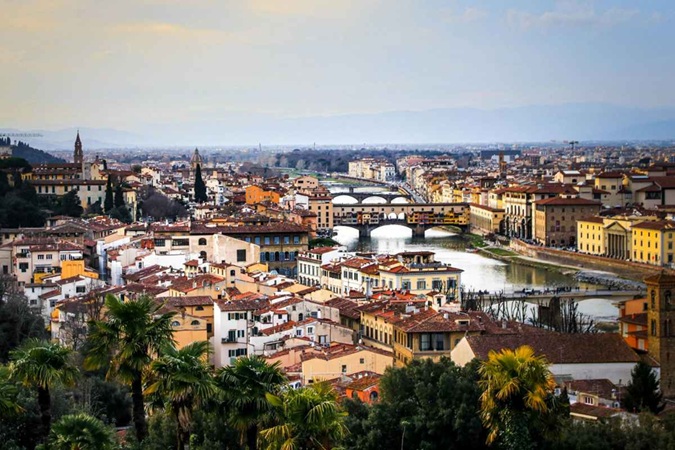

Florence is often described as an open-air museum, which is both accurate and slightly misleading. Museums suggest distance, labels, a prescribed route. Florence doesn’t work like that. Its buildings aren’t arranged to be admired in sequence; they’re arranged to be lived with. To understand the city, you don’t need to memorize dates or names. You need to pay attention to walls, proportions, wear — and to what has been left unchanged.
The City as a Palimpsest
Florence doesn’t erase. It layers. Medieval towers rise beside Renaissance palazzi. Baroque details interrupt severe facades. Even modern elements feel cautiously inserted, as if aware they are guests.
Once you notice this, the city becomes legible. Buildings stop being “beautiful” in the abstract and start telling quieter stories: who had power, who needed protection, who wanted to be seen — and who didn’t.
Stone That Signals Status
Florentine stone speaks clearly if you know how to listen. Rusticated blocks at ground level weren’t decorative bravado; they were statements of strength and permanence. Smooth upper floors suggested refinement, control, money that no longer needed to prove itself.
Walk past a palace like Palazzo Strozzi or Palazzo Medici Riccardi and you’ll see hierarchy embedded in the masonry itself. The lower you stand, the heavier the stone. Power, in Florence, was always grounded.
Windows as Social Clues
Look at the windows. In older buildings, they’re small, high, cautious. Privacy mattered. Security mattered more. Later facades grow more generous, more confident. Balconies appear. Light becomes something to invite rather than fear.
Even today, you can tell which buildings were meant for display and which were built for discretion. The city never flattened its social geography; it simply stacked it vertically.
Churches That Behave Like Civic Buildings
Florence’s churches don’t float above the city — they anchor it. Many feel almost severe on the outside, their interiors unfolding slowly, without theatrical gestures.
This restraint reflects a Florentine mindset: devotion without excess, beauty without surrendering to it. Even the Duomo, monumental as it is, feels architectural rather than emotional. It asserts reason as much as faith.
Streets Designed for Encounter, Not Spectacle
Florence’s streets rarely aim for drama. They narrow, bend, compress. Views are revealed late, often accidentally. This isn’t urban choreography for visitors; it’s an inherited logic shaped by commerce, defense, and habit.
It’s by following these quieter routes — the hidden corners of Florence where buildings press close and daily life still sets the pace — that the city becomes readable. Not iconic, but intimate.
Signs of Wear That Matter
Florence hasn’t polished away its age. Doorframes are smooth from centuries of hands. Stone steps dip in the middle. Walls bear marks that were never repaired because they didn’t need to be.
These imperfections are not neglect; they’re continuity. They remind you that the city didn’t stop once it became admired. It simply continued, at its own speed.
Domestic Architecture Tells the Truest Story
Grand monuments dominate memory, but Florence is best understood through its residential buildings. Modest facades, internal courtyards, shuttered windows — spaces designed to turn inward.
Florence has always been more private than performative. Even wealth expressed itself behind walls, not through them. The city’s real character lives where visitors rarely linger.
Learning to Read Without Interpreting Too Much
Reading Florence through its buildings doesn’t require expertise. It requires restraint. Looking without immediately categorizing. Letting structures exist before assigning meaning.
When you do that, Florence feels less like a masterpiece and more like a conversation — ongoing, unfinished, sometimes contradictory.
And perhaps that’s why it endures. Not because it demands admiration, but because it allows understanding to arrive slowly, one facade at a time.
