

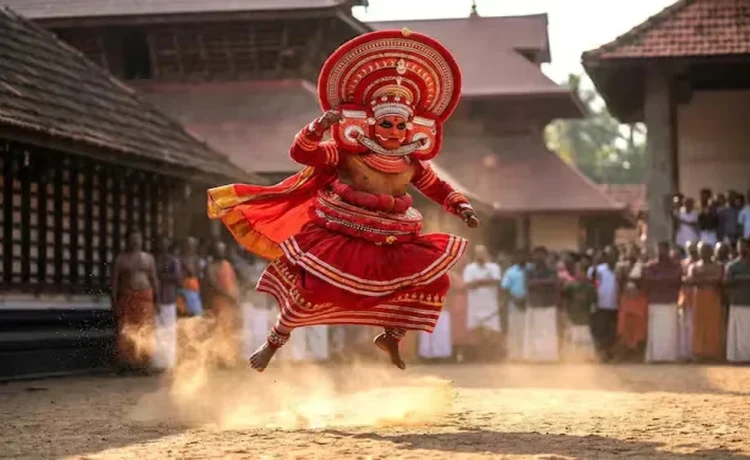

Kerala’s art forms range from the dance-dramas of Kathakali and Mohiniyattam to the ritual Theyyam of the north, the ancient Sanskrit theatre of Koodiyattam, the satire of Ottamthullal, and the martial art of Kalaripayattu. Some you watch as evening shows in Kochi, while others belong to temple festivals and keep to their own season.
What are the main Kerala art forms?
The main Kerala art forms fall into a few families. There is classical dance-drama, Kathakali and the gentler Mohiniyattam. There is the ancient Sanskrit theatre of Koodiyattam, the ritual performance of Theyyam in the north, the satirical solo of Ottamthullal, and temple percussion such as chenda melam. And there is Kalaripayattu, the martial art. Some are staged daily for visitors, while others belong to temples and festivals and follow their own calendar rather than a show schedule.
What is Kathakali, and where can you watch it?
Kathakali is Kerala’s best-known art form, a dance-drama that tells stories from the Mahabharata and Ramayana through stylised gesture and expression rather than speech. The look is unmistakable, with green and red painted faces, towering headdresses and wide skirts built up over hours of make-up. In Fort Kochi, cultural centres stage a condensed evening show for visitors, usually an hour or two, and it is worth arriving early to watch the performers paint and dress, which is half the spectacle. The full version, performed at temple festivals, can run most of the night. Its quieter companion is Mohiniyattam, a graceful solo dance performed mostly by women, built on slow, swaying movement.
Why is Koodiyattam a UNESCO art form?
Koodiyattam, also written Kutiyattam, is the oldest living Sanskrit theatre in India and the Kerala art form that carries real international recognition. UNESCO proclaimed it a Masterpiece of the Oral and Intangible Heritage of Humanity in 2001 and inscribed it on the Representative List in 2008. It is staged in temple theatres called koothambalams, and a single play can unfold over many hours across several nights, with an actor holding one emotion far longer than any modern stage would allow. It is rare and demanding to watch, so catch it when a festival or academy stages it rather than expecting a casual show.
What is Theyyam, and when is its season?
Theyyam is not a performance laid on for tourists. It is a ritual of north Malabar, in Kannur and Kasaragod, in which a performer becomes a deity in towering headgear and body paint, and is worshipped as that god for the hours of the rite. Performances take place at kaavus, the sacred groves and shrines, and at ancestral family houses, often through the night and into dawn. The season runs with the North Malabar temple calendar, roughly October to May, and the dates follow the Theyyam calendar rather than a fixed timetable. If you go, go as a respectful guest at someone’s sacred rite, not as an audience at a show.
What is Kalaripayattu, Kerala’s martial art?
Kalaripayattu is Kerala’s martial art and one of the oldest fighting systems anywhere, blending strikes, grapples, high leaps and weapons such as the staff, the sword and the flexible urumi. Training happens in a pit-floored arena called a kalari, and the discipline is tied to healing massage and body conditioning as much as to combat. You can watch demonstrations at kalaris in Fort Kochi and in Thiruvananthapuram (TRV, Trivandrum), where the spins, kicks and weapon sequences make for a gripping evening. It is a living practice, not a museum piece.
Where can you see Kerala’s art forms?
Fort Kochi is the easiest base, with daily evening shows of Kathakali, Kalaripayattu and often Mohiniyattam at its cultural centres. For the roots rather than the show, Kerala Kalamandalam near Thrissur, the state’s main academy for these arts, lets visitors watch training. Theyyam means heading north to Kannur in season, while temple festivals such as Thrissur Pooram are where the chenda percussion and the full-scale forms come alive. The table sums up where and when.
| Art form | Where to see it | When and note |
|---|---|---|
| Kathakali | Cultural centres in Fort Kochi; temples | Daily visitor show; full version at festivals |
| Mohiniyattam | Stages and cultural centres | Classical recitals, often paired with Kathakali |
| Koodiyattam | Koothambalams, festivals, academies | Rare and long; catch it when staged |
| Theyyam | Kaavus in Kannur and Kasaragod | North Malabar season, roughly October to May |
| Kalaripayattu | Kalaris in Fort Kochi, Thiruvananthapuram | Daily demonstrations |
| Ottamthullal | Temple festivals and stages | Short, satirical, widely performed |
Frequently asked questions
What is the most famous art form of Kerala?
Kathakali, the costumed dance-drama, is the best-known Kerala art form and the one most visitors see, usually as an evening show in Fort Kochi. Theyyam and Kalaripayattu are close behind in recognition. For international standing, Koodiyattam is the one UNESCO lists among the world’s intangible heritage.
Which Kerala art form is recognised by UNESCO?
Koodiyattam, the Sanskrit theatre, is the Kerala art form on UNESCO’s list. It was proclaimed a Masterpiece of the Oral and Intangible Heritage of Humanity in 2001 and inscribed on the Representative List in 2008. It is the oldest surviving Sanskrit theatre and is staged in temple theatres called koothambalams.
Where can I watch Kathakali in Kerala?
Fort Kochi is the usual place, where cultural centres stage a condensed evening show for visitors most days. Arrive early to watch the make-up, which takes hours and is half the spectacle. The full, traditional version is performed at temple festivals and can last most of the night.
When is the Theyyam season in Kerala?
Theyyam runs through the North Malabar temple season, roughly October to May, mainly in Kannur and Kasaragod. Exact dates follow the Theyyam calendar at each kaavu rather than a fixed timetable, so check locally. Remember it is a sacred ritual, often at night or dawn, not a show arranged for tourists.
Is Kalaripayattu the oldest martial art?
Kalaripayattu is widely described as one of the oldest martial arts still practised, with roots in Kerala going back many centuries. It combines unarmed combat, weapons and healing traditions. You can watch demonstrations at kalaris in Fort Kochi and Thiruvananthapuram, where it is a living practice rather than a staged relic.
Do I need to understand the stories to enjoy Kathakali?
No, though a little background helps. The gestures and expressions carry the plot, and most visitor shows begin with a short explanation of the hand signs and the scene. Watching the make-up and the live music is rewarding on its own, so you can enjoy the spectacle without knowing the epic by heart.
To know more information about Kerala tourism, check out trip2keralam.com
